A Decision Intelligence Platform for Business Impact
Moving Beyond AI Toward Decisions That Actually Matter
Moving Beyond AI Toward Decisions That Actually Matter
Background
Many enterprises are investing heavily in machine learning (ML), large language models (LLMs), and more recently, agentic AI, in pursuit of operational innovation. However, only a small fraction of these initiatives result in clear, measurable business outcomes. According to McKinsey’s The State of AI in 2025, fewer than 6% of companies report an increase of more than 5% in EBIT as a direct result of AI adoption. This gap highlights a fundamental issue: AI technologies are rarely connected to the way real business decisions are made. While organizations establish AI teams and experiment with advanced technologies, actual business decisions continue to be made within frontline business units. As a result, AI initiatives often remain isolated from real decision-making processes and fail to deliver sustained impact. More fundamentally, business decisions cannot be driven by data alone. They require consideration of external market trends not captured in data, competitive dynamics, regulatory constraints, and expert judgment. Because of this, it is structurally impossible for AI technologies alone to cover the full scope of real-world decision-making.
What Is a Decision Intelligence Platform?
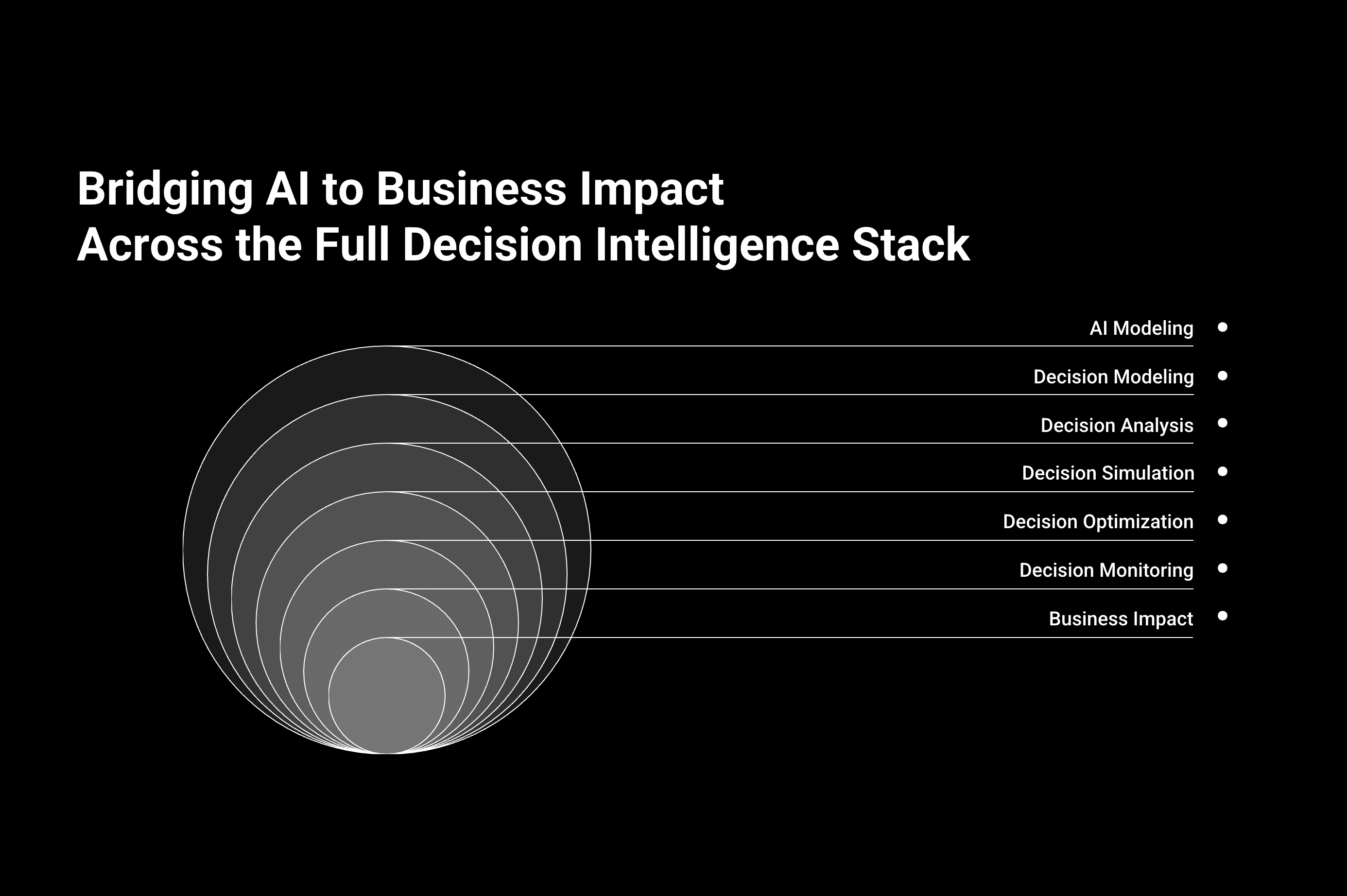
Decision Intelligence is not simply another form of AI. It is a comprehensive framework that encompasses the processes, culture, and software capabilities required to systematically improve an organization’s decision-making ability. Rather than focusing on a specific technology such as deep learning or LLMs, a Decision Intelligence Platform supports the end-to-end software stack needed to make, evaluate, and improve business decisions. It goes beyond prediction and automation by enabling interaction between AI and human decision-makers through visualization, simulation, optimization, and monitoring. The goal is not to replace humans with AI, but to elevate decision quality by combining machine intelligence with human judgment.
Core Capabilities of Decision Intelligence
1. Decision Modeling
Traditional AI models are designed to predict outcomes based on historical data. Decision models, by contrast, are designed to integrate all relevant factors influencing a decision—including data, business rules, constraints, and strategic objectives—to support actionable choices. Their purpose is not prediction alone, but the delivery of decisions that can be executed in real business environments.
2. Decision Analysis
To achieve business objectives, organizations must first understand their current situation and identify where decisions truly matter. Conventional dashboards and visualizations often lack evaluative power, providing fragmented insights due to siloed data. Decision Analysis, supported by meta-intelligence, integrates and quantifies information across the enterprise, enabling decision-makers to clearly identify critical decision points and trade-offs.
3. Decision Simulation
Every decision produces side effects. For example, reducing production may lower excess inventory but simultaneously increase the risk of stockouts and lost sales. Decision Simulation allows organizations to explore these interactions before acting, helping decision-makers understand the multi-dimensional impact of their choices and align decisions with long-term profit optimization rather than short-term gains.
4. Decision Optimization
As business environments grow more complex, the volume of data and number of constraints far exceed human cognitive capacity. Under these conditions, manually identifying optimal strategies becomes nearly impossible. Decision Optimization techniques uncover patterns and opportunities hidden within large-scale data, revealing new strategic options and business opportunities that would otherwise remain invisible.
5. Decision Monitoring
In rapidly changing markets, the ability to continuously monitor decisions and respond in a timely manner is critical. While MLOps and ModelOps focus on model performance and data drift, these metrics often show weak correlation with actual business outcomes. Decision Monitoring shifts the focus from models to decisions themselves, automatically surfacing decision points that require attention and enabling organizations to respond proactively to change.
From AI Adoption to Business Impact
A Decision Intelligence Platform bridges the gap between AI capabilities and real-world business impact by aligning intelligence, judgment, and execution around what matters most: better decisions and measurable results.
See how this logic applies to your business. Contact us today.